Dogs in Ancient India and Hindu Mythology
Introduction: The Spiritual Significance of Dogs in Indian Civilization
Dogs have walked beside humanity for millennia, but in Ancient India, they assumed roles far beyond mere companionship. Dogs appear in the Vedas, epics like the Mahabharata, and temple iconography, often embodying concepts of loyalty, dharma, guardianship, and spiritual power. They are revered in myth, feared in rituals, and loved in rural traditions, making them multifaceted figures in Hindu cosmology.
Dogs in Vedic Literature
One of the earliest references to a dog in Hindu scripture is Sarama, the divine hound of the Rigveda. Sarama is depicted as a celestial messenger who locates the stolen cows of the gods, symbolizing divine intuition and loyalty. She is referred to as Deva-shuni, or “dog of the gods.”
The Atharvaveda includes incantations involving dogs, often invoking their power to ward off danger. In some hymns, dogs symbolize protection and watchfulness, while in others, they are invoked in curses—demonstrating the duality of their perception.
Canines in the Mahabharata and the Story of Yudhishthira
The Mahabharata features the most spiritually profound dog tale in Hindu literature. Yudhishthira, the eldest Pandava, is accompanied by a dog as he climbs Mount Meru in his final journey. When Indra invites him to heaven but refuses the dog entry, Yudhishthira declines, saying he cannot abandon one who has shown him such loyalty. The dog reveals himself to be Dharma, the god of righteousness.
This story illustrates the core Hindu value of loyalty over personal gain, and the dog becomes a divine tester of human integrity.
Dogs in the Ramayana and Other Hindu Epics
Although less central in the Ramayana, dogs still appear in stories related to dharma and karma. In some lesser-known versions, Lord Rama speaks about compassion toward animals as a measure of spiritual maturity. These stories reflect the doctrinal alignment between kindness to animals and spiritual evolution.
The Dog as the Vahana of Hindu Deities
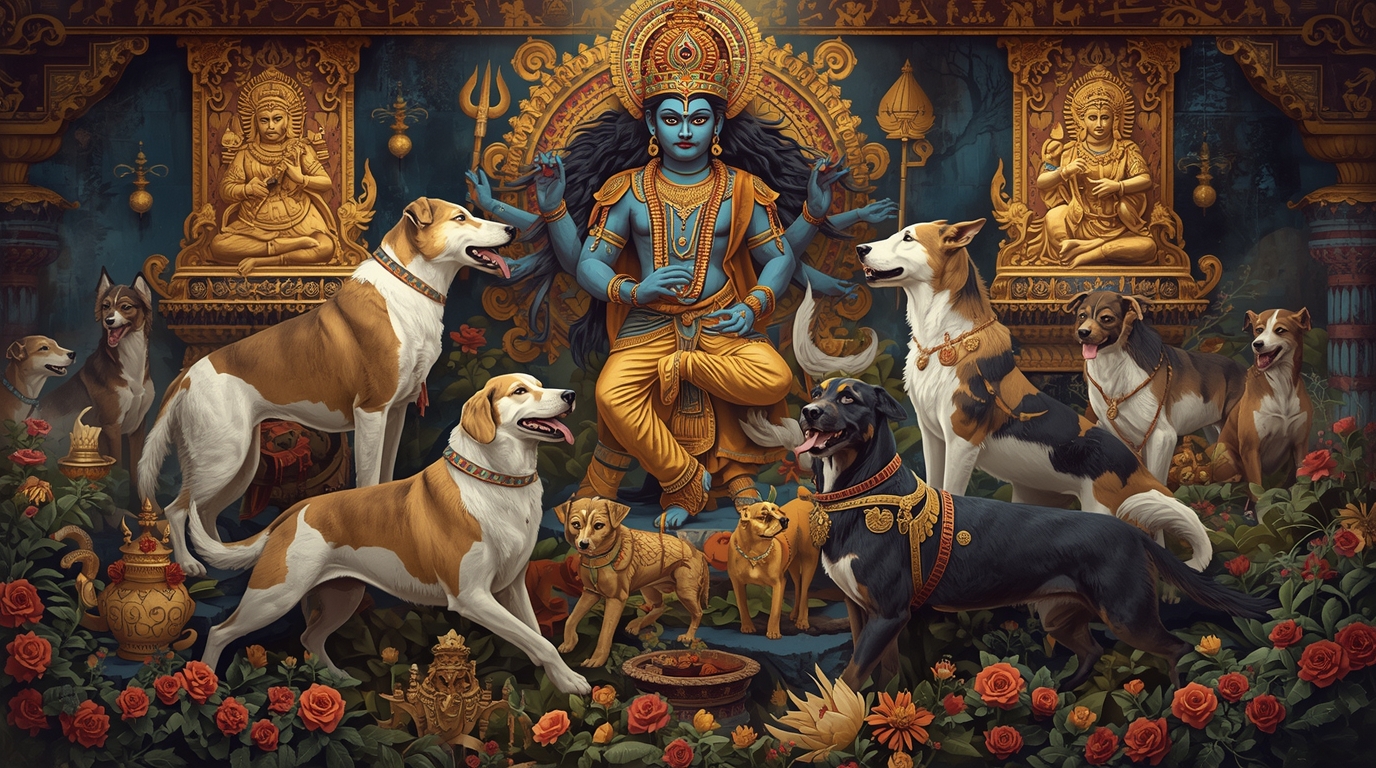
In Hindu iconography, Bhairava, a fierce manifestation of Shiva, rides a black dog. This association transforms the dog into a symbol of protection, justice, and boundary-defying power. Bhairava is worshipped especially in cremation grounds, where dogs roam freely, symbolizing the thin veil between life and death.
Dattatreya, the trinity god, is often surrounded by four dogs, each representing one of the Vedas—indicating dog as a guardian of sacred knowledge.
Dogs in Puranic Stories and Symbolism
The Puranas are rich in stories where dogs appear as messengers of gods or omens of fate. Sarama’s offspring, referred to as Sarameyas, are described as the two four-eyed dogs that guard the gates of Yama, the god of death. These celestial canines are responsible for guiding souls and punishing the unrighteous.
The Role of Dogs in Hindu Dharma
In Hindu thought, dogs embody the dharmic qualities of loyalty, humility, and non-attachment. They live without pride, sleep on the ground, eat leftovers, and yet remain unwaveringly loyal. This symbolism is reflected in stories where devotees who feed or care for dogs gain spiritual merit.
Dogs as Guardians of Sacred Spaces
In many Bhairava temples, especially in South India, live dogs are fed and revered. It is considered auspicious to offer food to dogs near shrines as an offering to Bhairava himself. In temples of Dattatreya, four dog statues always stand at the corners of the deity, guarding him and symbolizing his cosmic knowledge.
Hindu Astrology and the Zodiac Dog
While the dog is not part of the 12 traditional Hindu zodiac signs, it is associated with Ketu, the South Lunar Node. Ketu represents detachment and spiritual liberation—qualities attributed to dogs in mystical texts. In tantric astrology, dogs are said to absorb negative planetary energy, and their behavior is often interpreted as omens.
Dogs in Rituals and Religious Observances
Feeding dogs during Pitru Paksha, the fortnight dedicated to ancestors, is a way to honor Yama, who is associated with dogs. Food offered to stray dogs is believed to reach deceased ancestors. During Shraddha ceremonies, dog sightings are considered signs of successful rites.
Canine Symbolism in Tantric Practices
In Tantra, dogs are paradoxically seen as both impure and sacred. They accompany sadhus in cremation grounds, symbolizing ego, lust, or death—forces the practitioner must overcome. In Kapalika and Aghori sects, dogs are spiritual mirrors of detachment and primal instinct, bridging animal nature and divine consciousness.
Cultural Attitudes Toward Dogs in Ancient India
Dogs held both sacred and polluted status, depending on caste and regional beliefs. In rural India, dogs were treated as family protectors and household members. However, orthodox Brahminical society often considered them unclean due to their scavenging behavior, especially in urban centers.
This duality reflects India’s philosophical embrace of contradiction, where an animal can be both revered and rejected.
Dogs in Indian Folklore and Oral Traditions
Folk tales in the Panchatantra feature dogs as clever, loyal, and morally upright characters. They often teach lessons about trust, betrayal, and justice. In rural storytelling, heroic dogs rescue children, expose thieves, or even lead blind masters—echoing real-life admiration for their intelligence.
The Philosophical Meaning of the Dog in Hindu Thought
In Advaita Vedanta, the dog can represent maya (illusion) or bhakti (devotion), depending on interpretation. A common adage says, “Even a dog that follows the sadhu attains moksha,” underscoring the value of satsang (holy company) and spiritual discipline.
Temple Architecture and Dog Depictions
In Hoysala and Chola temples, dogs appear carved into base panels, especially near Bhairava idols. These dogs are muscular, alert, and sometimes wearing collars—depicting them as spiritual warriors and protectors.
The Sacred Geography of Dogs in India
Kashi (Varanasi) is the city of Kala Bhairava, whose vehicle is a black dog. Devotees offer food to street dogs before visiting his temple, believing this pleases the deity. In Nepal, the Day of the Dog (Kukur Tihar) celebrates dogs with garlands and sweets—another extension of the dog’s spiritual role in the subcontinent.
Women and Dogs in Hindu Texts and Society
In several Shakti cults, women are portrayed with dogs symbolizing fierce independence. Goddesses like Chamunda are accompanied by jackal or dog-like creatures, emphasizing their dominion over life and death.
Royal women also kept dogs for companionship, and references to female ascetics with dogs exist in Bhakti literature.
Modern Legacy: Dogs in Indian Religion Today
Even today, dogs are part of Indian religious culture. In Tamil Nadu, Koothandavar temples include dogs in festivals. In Varanasi, dogs are guardians of Aghori spaces. Many devotees regularly feed stray dogs as a religious act.
The belief in dogs as souls in waiting, or as carriers of dharma, continues through rural customs and temple rites.
The Dog and the Caste System: Social Symbolism
In some texts, dogs are aligned with lower castes, yet their loyalty and spiritual merit are seen as redeeming qualities. This paradox reflects Hinduism’s capacity for transcendence—where even the lowly can become divine.
Yudhishthira’s refusal to abandon his dog reflects this: caste, status, or form do not determine worth—dharma does.
Conclusion: Eternal Companions in the Indian Soul
Dogs in Ancient India and Hindu mythology transcend their physical form. They are symbols of dharma, sacrifice, loyalty, and divine guardianship. Whether accompanying gods or testing kings, dogs remind us that the path to moksha is walked with humility and constancy. In temples, stories, and rituals, the dog remains not just man’s best friend—but also the spiritual seeker’s eternal companion.